

CISO’s Guide to Prioritizing Weaknesses Over Threats
Detecting and responding to incidents has long been at the core of security operations. However, today’s evolving threats mean CISOs should also focus on proactive attack prevention.
Let us look at the Prevent-First approach.
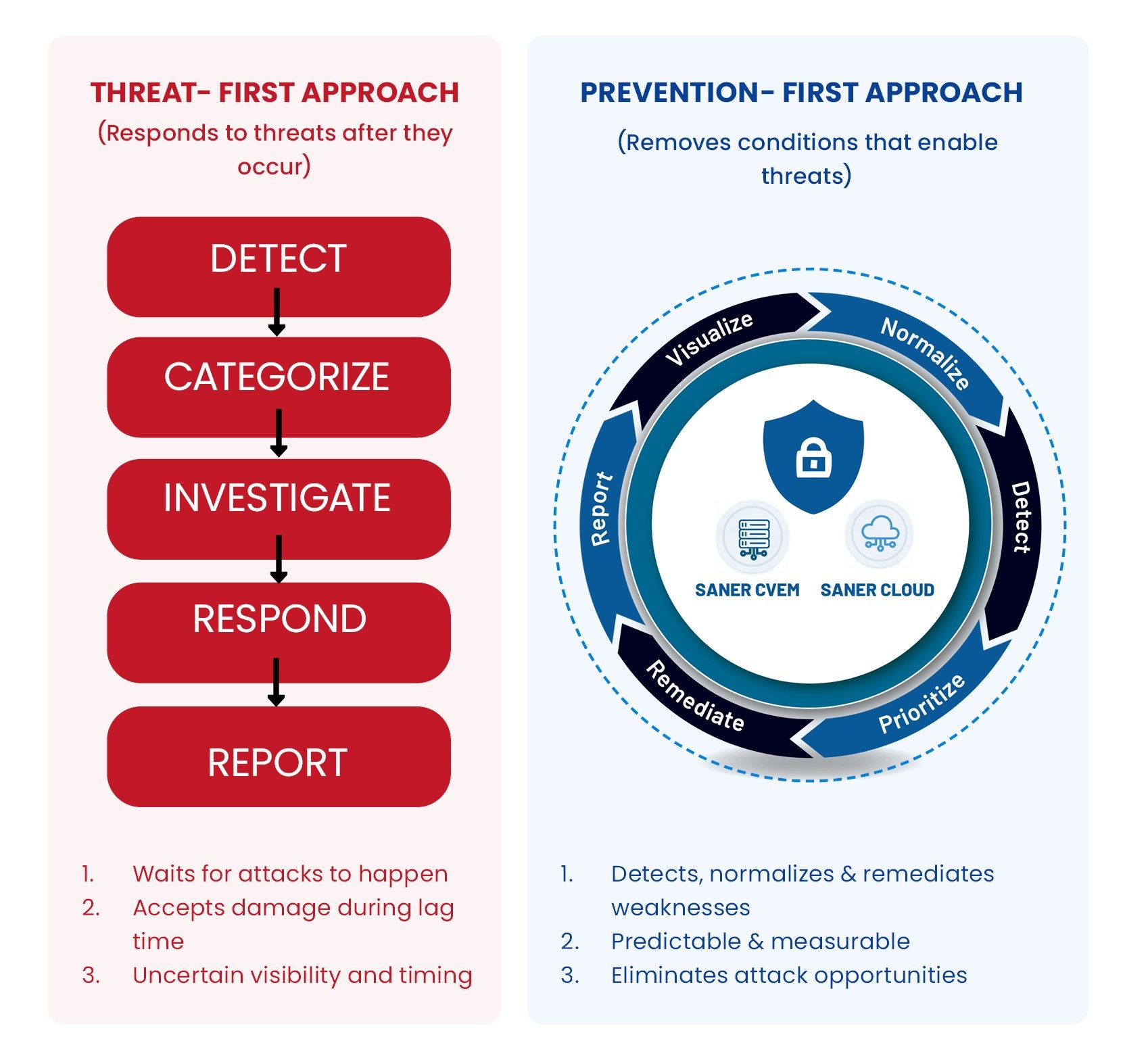
This approach is centered on identifying and eliminating weaknesses before threats can materialize. If you look at a threat, its outcome is very conditional. An exploit occurs only if a weakness exists and an attacker takes advantage of it. Eliminating weakness reduces the probability of an attack to near zero.
In contrast, responding to a threat after detection accepts the continued presence of weaknesses and assumes a lag before action, during which damage might have already occurred.
Attack Probability after Prevention

Answer To Two Key CISO Questions
CISOs must evaluate the expected value of two actions. Is it more valuable to wait for an event with uncertain timing and visibility, or to act upon the known, measurable presence of security weaknesses?
Prevent-First favors the latter, not to avoid detection and response but by investing early in measures that can most effectively reduce risk.
Weakness prevention is more predictable as it reliably remediates vulnerabilities, misconfigurations, and anomalies. Prevent-First security approach maximizes risk reduction through direct action on root causes. Instead of chasing threats, it eliminates the opportunity for threats to succeed.

Why The Threat-Centric Model Falls Short
REACTIVE, POINT IN TIME POSTURE
The threat-centric model revolves around detecting or simulating attacks after a vulnerability is live. It has manual, static controls, which adopt a siloed approach that fragments defense layers. In practice, defenders chase alerts and exploits rather than eliminating root causes.
SEVERIETY OVER RISK
Traditional vulnerability management tools score flaws by CVSS severity, not by actual business risk. Teams fix high-severity issues that may never be exploited while neglecting more critical weaknesses. This is a severe misalignment.
COMPLEXITY AND SILOED TOOLS
Blending dozens of point tools, scanners, SOARs, MDR, XDR, EDR, SIEMs, threat feeds, etc., creates operational overload. Analysts drown in alerts and struggle to detect, prioritize, and respond.
Why Prevent First Excels
Prevent First uses continuous vulnerability discovery, normalization, prioritization, and automated remediation. By eliminating root weaknesses, the probability of any threat and thus overall risk collapses regardless of impact.
Key Advantages:
Eliminates Root Causes: Targeting vulnerabilities and misconfigurations before they become exploitable.
Reduces Risk Continuously: Focusing on weakness prevention drives the “probability of threat” in the risk equation to near zero
Streamlines Operations: Disciplined vulnerability remediation workflows replace noisy alert triage with predictable, measurable improvement
Aligns with Business Priorities: Remediation is guided by actual exposure and impact.
Targets What Matters: Fixes the vulnerabilities, misconfigurations and anomalies adversaries would exploit
Delivers Measurable Gains: Tracks reduction in open vulnerabilities and exposure metrics
Aligns with Business Risk: Prioritizes fixes by their potential business impact and exploitability
The Weakness Core - What Attackers Target
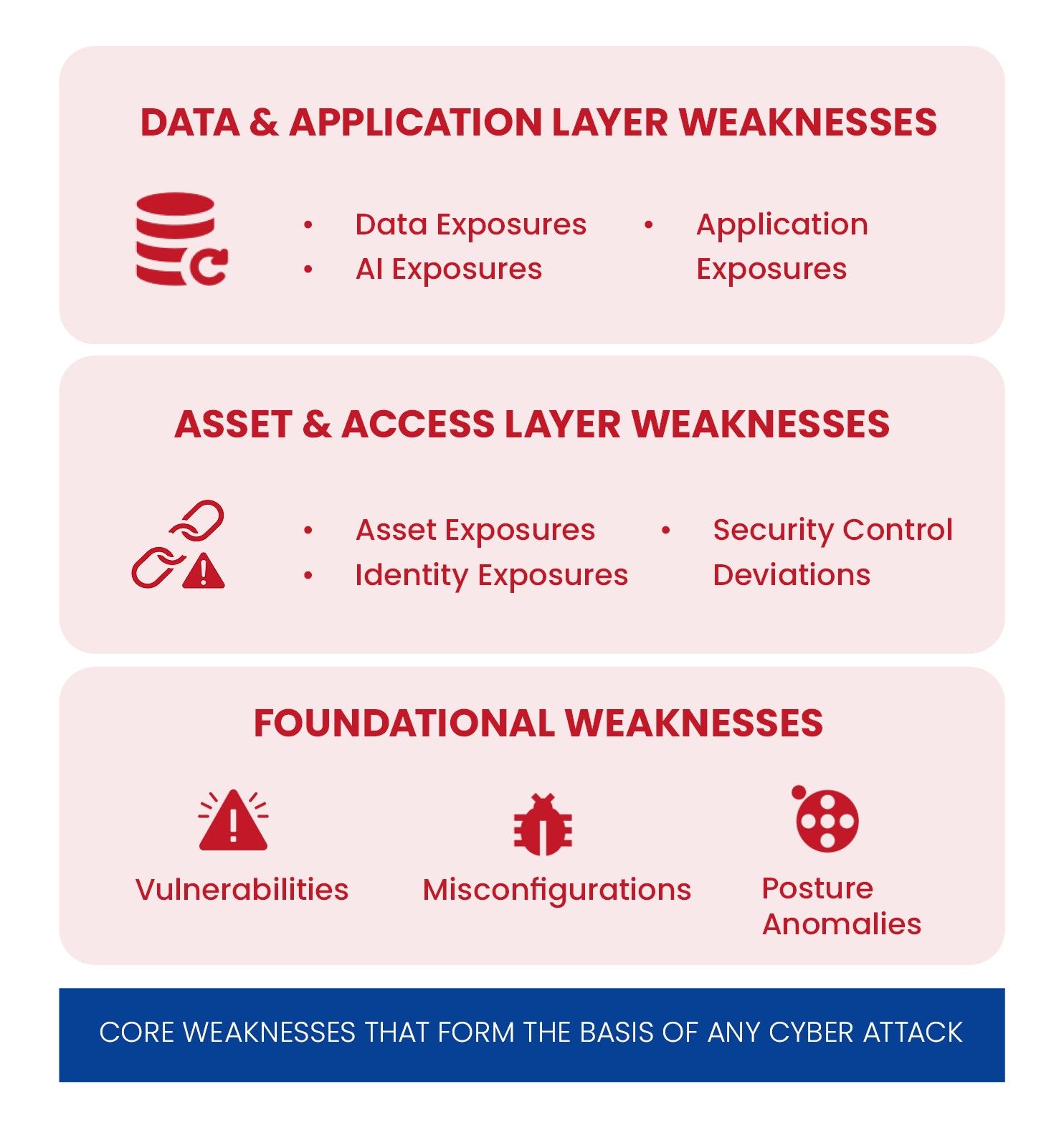
Every security posture rests on a core of latent weaknesses. This core forms the ground for any analysis related to a system compromise. Each weakness, whether a vulnerability, anomaly, misconfiguration, asset exposure, security controls deviations,
identity exposures, data exposures, AI exposures, or application exposures acts like a clue that suggests an asset might be at risk. The more of these weaknesses present, the higher the chance of exploitation. If attackers discover exactly which vulnerabilities, misconfigurations, or anomalies exist in your environment, they no longer need to guess or probe.
Instead of treating security issues in isolation, analyzing them as part of the weakness core allows you to:
- Anticipate attacker pathways before exploitation
- Prioritize remediation where it will have the highest impact
- Reduce your attack surface
This lowers their effort needed to exploit a system, making even low-priority weaknesses viable attack paths. What was once improbable becomes a preferred entry point. That’s why continuously eliminating weaknesses is critical. It not only strengthens your defense but also denies attackers the intelligence they rely on to breach.

Why CISOs Must Rethink The Threat-First Strategy
CISOs are often asked to justify shifts in strategy using projections, maturity models, or industry benchmarks. But the most decisive pivot happens not because of frameworks, but when the math breaks.

For e.g., when the likelihood of threat approaches 1 (which means the attack is certain, if it is 0 attack is not sure), as attackers probe continuously, even minor weaknesses are targeted, the impact grows with the attack surface. This leads to longer MTTD and MTTR, resulting in direct cost increases.

Building the Prevent-First Security Posture using the Saner Platform
The Saner Platform, a unified, integrated platform purpose-built to address the full spectrum of enterprise security weaknesses, makes a prevent-first security posture achievable. Saner consolidates asset exposure, vulnerability management, posture anomaly management, patch management, risk prioritization, and endpoint management into a single platform for complete visibility and control across devices and cloud environments.
Using automation, unified security intelligence, and a hybrid architecture, Saner identifies and eliminates core weaknesses, such as vulnerabilities, misconfigurations, and posture anomalies, before they can be exploited. Let’s explore how two foundational equations which we discussed earlier, shows how SecPod’s Saner platform is designed to minimize risk by actively reducing each component of these equations.
A. Risk = Probability of Threat × Impact
This equation tells us: if a threat is highly probable and the impact is high, your risk is maximal.
1. The probability of threats is rising due to constant automated scanning by
adversaries. Even rare vulnerabilities are now regularly probed.
2. Impact grows with expanding attack surfaces, misconfigurations, and unpatched
assets.
Saner reduces both sides of this equation to minimize overall risk.
MINIMIZING THE PROBABILITY OF THREAT
• Saner continuously detects and remediates vulnerabilities and posture anomalies before they can be exploited
• It reduces the time a weakness remains exploitable (exposure window), effectively reducing the threat probability
MINIMIZING IMPACT
• By controlling exposure and ensuring security posture is hardened across cloud,
endpoints, OS, and applications
• SSVC risk-based prioritization of critical assets ensures rapid remediation
B. Threat = Vulnerability x Exposure
A vulnerability only becomes a threat when it is exposed. Traditional scanners detect vulnerabilities but ignore other exposures, blinding CISOs to real threats.
Saner breaks the threat chain in three ways by eliminating exposure and maintaining hardened configurations.
UNIFIED DETECTION, NORMALIZATION, AND REMEDIATION
Identifies, normalizes, and remediates not just CVEs, but misconfigurations, shadow IT, unwanted apps, unsigned apps, malicious processes, outbound connections, unusual ports, inactive users, and everything that constitutes exposure
CORRELATES EXPOSURE CONTEXT
Saner doesn’t stop at detection. It maps vulnerabilities to business context and exposure conditions, such as whether a vulnerable service is running, misconfigured, or communicating outside the enterprise IT environment.
CONTINUOUS SCANS AND ASSESSMENT
Exposure is not static. Saner continuously scans, detects, and assesses posture drift, asset changes, and vulnerable risks critical for cloud and endpoint infrastructure.

Saner Platform for Device and Cloud Security
Saner platform offers integrated security for endpoints and cloud by combining visibility, normalization, risk prioritization, and remediation across environments. The platform enables the next wave of security transformation by assisting in modernizing your cloud and device exposure management efforts by reducing complexity at scale.

